Overview
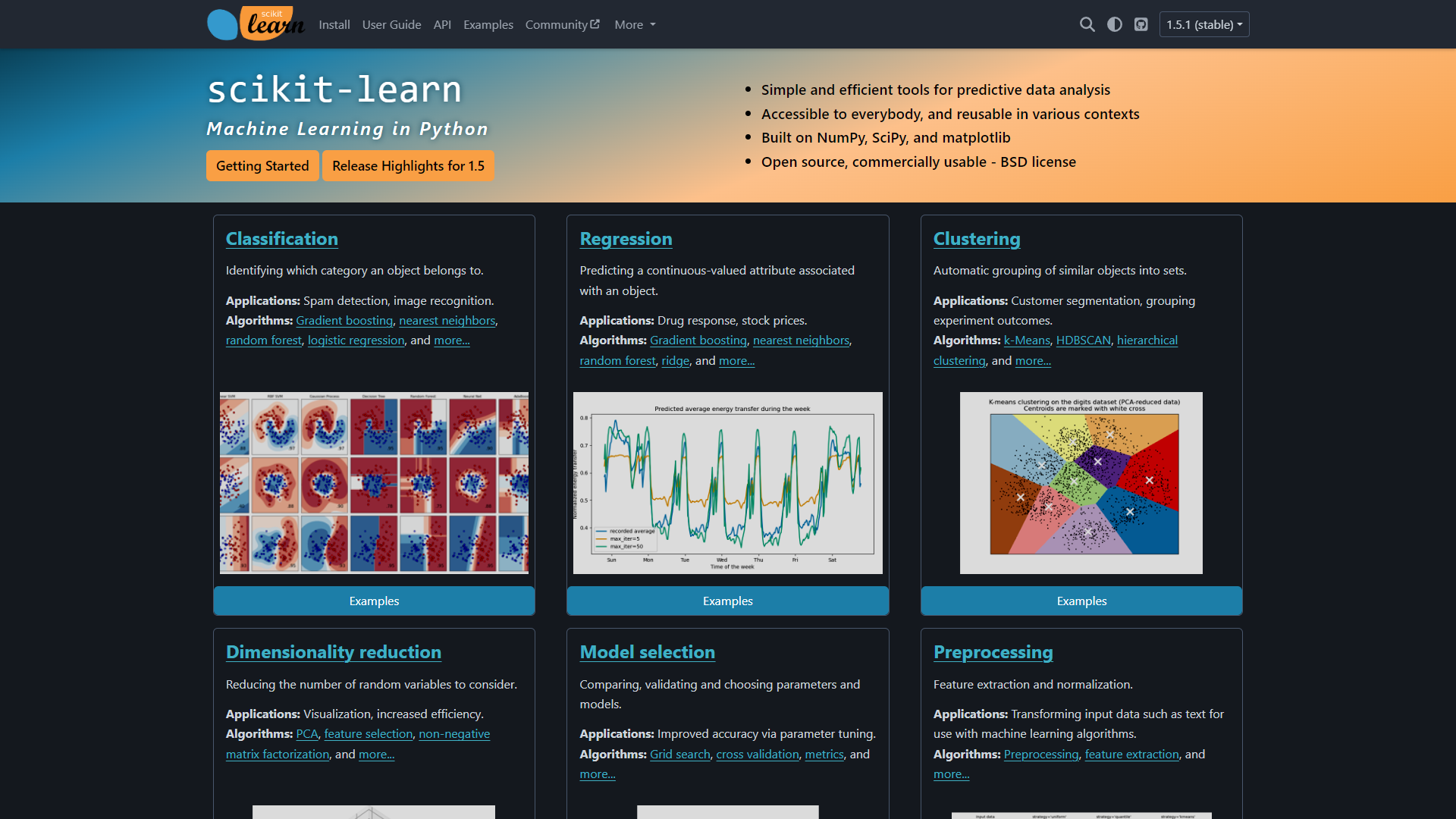
Scikit-learn is an open-source machine learning library for Python. It provides simple and efficient tools for data mining and data analysis. The library is built on NumPy, SciPy, and matplotlib, making it easy to integrate with other scientific computing libraries in Python.
With scikit-learn, users can easily build and evaluate machine learning models for various tasks, including classification, regression, clustering, and more. It’s designed to be accessible and reusable, allowing both new and experienced programmers to implement machine learning techniques effectively.
Scikit-learn also features a comprehensive set of algorithms and utilities. It covers a wide range of tasks, from preprocessing to model selection and evaluation. This makes it a versatile choice for anyone looking to harness the power of machine learning in their projects.
Pros
- User-Friendly
- Strong Community Support
- Extensive Documentation
- Integration with Other Libraries
- Versatile
Cons
- Limited to Python
- Memory Intensive
- Not for Deep Learning
- Steep Learning Curve
- Less Suitable for Unstructured Data
Key features
Wide Range of Algorithms
Scikit-learn supports various algorithms for classification, regression, and clustering.
Cross-Validation
It provides tools for cross-validation, helping to assess how the results of a statistical analysis will generalize.
Preprocessing
Users can preprocess data easily, including scaling and normalization.
Model Selection
The library helps users to choose the right model and fine-tune parameters with grid search.
Easy Integration
Scikit-learn works well with other Python libraries like NumPy and pandas.
Pipeline Tools
Users can combine multiple steps into a single composite estimator for easier workflow management.
Visualization
It includes tools for visualizing data and model performance.
Documentation
Scikit-learn is well-documented, making it easier for users to learn and find help.
Pricing
| Plan | Price | Description |
|---|---|---|
| Mid-Market | N/A | - |
| Enterprise | N/A | - |
Rating Distribution
Company Information
User Reviews
View all reviews on G2Python library
What do you like best about scikit-learn?
Users who wish to connect the algorithms to their platforms will find detailed API documentation on the scikit-learn website. Many contributors, authors, and a large international online community support and update Scikit-learn. It is easy to use. The libra...
Best open source library for Machine learning.
What do you like best about scikit-learn?
I like how dynamic scikit-learn library is. it provides preloaded and ready-to-use functions for all sorts of machine learning and data preprocessing algorithms.
What do you dislike about scikit-learn?
The only downside is the lack of native support for dee...
scikit-learn
What do you like best about scikit-learn?
Scikit-learn is built on top of efficient numerical libraries, such as NumPy and SciPy, which provide optimized implementations of mathematical and numerical operations. This ensures that the library can handle large datasets and complex computations efficie...
Machine Learning Library You Need to Know
What do you like best about scikit-learn?
The best thing, as per me, is there is documentation available of scikit-learn. So, if I sometimes find it difficult to apply some algorithms, I can check the documentation, which helps me. I like this thing. Scikit-learn also provides many inbuilt datasets ...
scikit-learn is the best machine learning library for the python platform
What do you like best about scikit-learn?
scikit-learn library is very easy to import and ready to use for the python platform. It also contains some sample datasets for trying machine learning algorithms.
What do you dislike about scikit-learn?
There is as such no point that I dislike in scikit-le...
Alternative Machine Learning tools
Explore other machine learning tools similar to scikit-learn





FAQ
Here are some frequently asked questions about scikit-learn.
What is scikit-learn?
Scikit-learn is an open-source machine learning library for Python that offers tools for data analysis and model training.
How do I install scikit-learn?
You can install scikit-learn using pip by typing 'pip install scikit-learn' in your command line.
What types of machine learning does scikit-learn support?
Scikit-learn supports supervised and unsupervised learning, including classification, regression, and clustering.
Can I use scikit-learn with large datasets?
Scikit-learn can handle large datasets, but performance may vary based on memory and processing power.
Is scikit-learn free to use?
Yes, scikit-learn is open-source and free, released under the BSD license.
Do I need to be an expert to use scikit-learn?
No, scikit-learn is user-friendly, making it accessible for beginners as well as experienced developers.
What should I learn first before using scikit-learn?
It is helpful to have a basic understanding of Python and some knowledge of statistics and data analysis.
Is scikit-learn suitable for deep learning?
No, scikit-learn is not designed for deep learning. Libraries like TensorFlow or PyTorch are better for that purpose.