

Overview
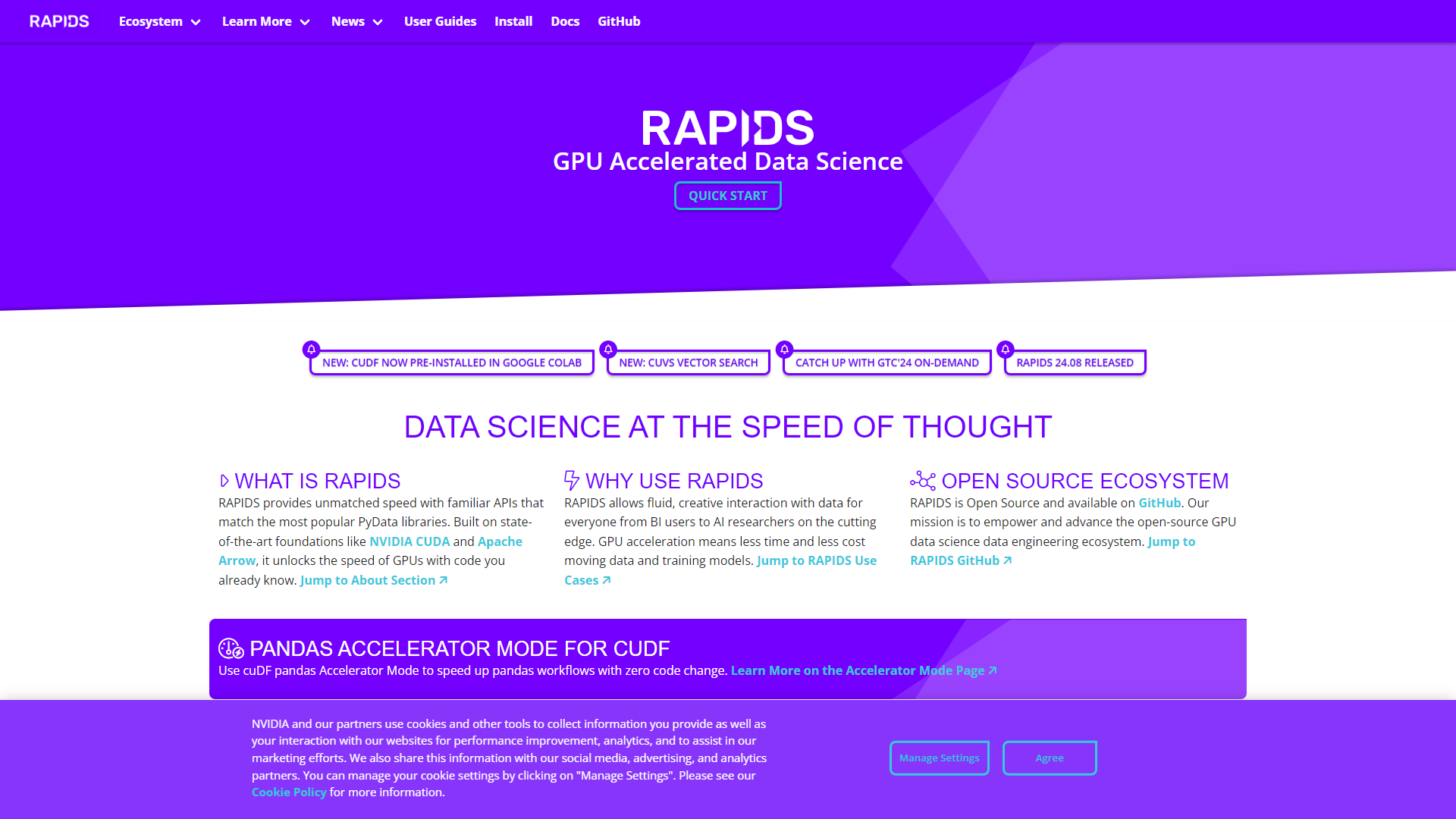
RAPIDS is a powerful open-source software suite designed to help data scientists and developers with big data analytics. It leverages the performance of GPU computing to speed up data processing tasks, making it easier and faster to analyze large datasets. With RAPIDS, you can run your data science workflows using familiar tools like Python, which makes it accessible for many users.
This suite brings together various libraries that work seamlessly together to enable data manipulation, machine learning, and graph analytics. It's particularly useful in environments where performance and speed are crucial. The goal of RAPIDS is to provide a unified tool for data scientists that can simplify the computational tasks and enhance productivity.
RAPIDS also supports popular platforms and formats, which allows users to incorporate it into their existing workflows easily. The dedication to open-source means that the community can contribute to its development, ensuring it stays cutting-edge and responsive to the needs of users.
Pros
- Speed
- Familiarity
- Flexibility
- Community Contributions
- Scalability
Cons
- Learning Curve
- Hardware Requirements
- Limited Compatibility
- Documentation
- Performance Variability
Key features
GPU Acceleration
RAPIDS leverages the power of GPUs to significantly speed up data processing tasks, making large-scale analytics faster.
Seamless Integration
This suite integrates smoothly with existing data science tools and frameworks, like PyData and Apache Arrow.
DataFrame Support
RAPIDS includes a DataFrame API that is similar to pandas, allowing users to perform complex data manipulations easily.
Machine Learning
It offers machine learning libraries that allow users to build, train, and validate models directly on GPUs.
Graph Analytics
RAPIDS includes functionality for graph analytics, allowing users to analyze networks and relationships in data effectively.
Visualization Tools
The suite provides tools to visualize large datasets, which helps in interpreting results and sharing insights.
Open Source
Being open-source means that it's free to use, and users can contribute to its development.
Community Support
RAPIDS has a growing community that offers support, tutorials, and shared resources for users.
Rating Distribution
Company Information
User Reviews
View all reviews on G2When Numpy and Pandas isn't enough
What do you like best about RAPIDS?
Sometimes, in classical Machine Learning, the speed offered by the PyData ecosystem is simply not fast enough. Tools like Dask and Vaex help and running jobs on a Spark cluster is often a neat solution as well, but sometimes you need a bit more than that.
That's ...
Alternative Machine Learning tools
Explore other machine learning tools similar to RAPIDS






FAQ
Here are some frequently asked questions about RAPIDS.
What is RAPIDS?
RAPIDS is an open-source suite designed for accelerated data science, enabling faster data processing using GPUs.
Who can use RAPIDS?
Data scientists, developers, and anyone working with big data analytics can benefit from RAPIDS.
What programming language does RAPIDS use?
RAPIDS is primarily designed for Python, making it accessible for most data scientists.
Do I need a GPU to use RAPIDS?
Yes, RAPIDS is optimized for GPU performance, and using one is essential to achieve the best results.
Can RAPIDS be integrated with existing workflows?
Absolutely! RAPIDS integrates with popular data science tools and frameworks for seamless use.
Is RAPIDS free to use?
Yes, RAPIDS is an open-source suite, so it is free for anyone to download and use.
What types of analytics can I perform with RAPIDS?
You can perform data manipulation, machine learning, and graph analytics using RAPIDS.
How does RAPIDS enhance performance?
RAPIDS offloads computational tasks to the GPU, allowing for much faster data processing compared to CPUs.